
Phantom MK1: The Bipedal Soldier and the Future of War in Ukraine
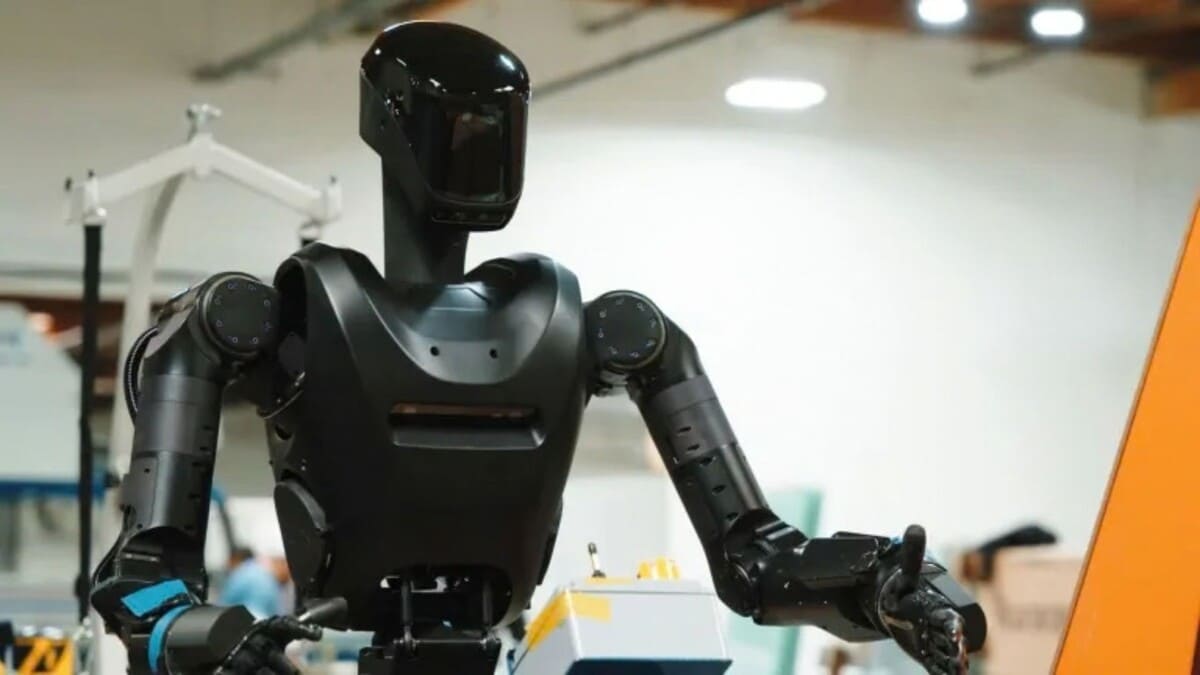
The Phantom MK1 represents a conceptual departure from earlier unmanned ground systems such as tracked or wheeled robots. Instead of adapting machines to the terrain through tracks or multiple wheels it seeks to replicate the fundamental mode of human movement: walking. This shift is not merely aesthetic. It reflects an attempt to solve one of the most persistent problems of ground robotics, namely the difficulty of navigating complex, irregular environments that were built for human bodies rather than machines.
Ukraine’s front lines present precisely such environments. Trenches, shattered buildings, forests filled with debris and narrow urban passageways all favour human mobility. Traditional unmanned ground vehicles often struggle in these conditions. Tracks become entangled, wheels lose traction, and rigid chassis cannot easily adapt to vertical obstacles. A bipedal system such as Phantom MK1, in theory, can step over obstacles, climb stairs and manoeuvre through confined spaces in a manner far closer to that of a human soldier.
The Phantom MK1 is reportedly being tested as part of Ukraine’s ongoing effort to expand the role of robotics in combat operations. While precise technical specifications remain closely guarded, the general concept is clear. It is a remotely operated or semi-autonomous platform capable of carrying sensors, communications equipment and, potentially, weapon systems. Its human-like gait allows it to enter environments that would otherwise require the physical presence of soldiers.
The implications for reconnaissance are immediate. A bipedal robot can move quietly through damaged structures, ascend staircases and observe enemy positions from vantage points inaccessible to tracked vehicles. Equipped with cameras and thermal imaging systems, Phantom MK1 can relay real-time intelligence to operators located at a safe distance. In a war where situational awareness often determines survival, such capabilities are invaluable.
There is also the possibility of direct combat application. A humanoid platform could in principle be equipped with small arms or other weapons, allowing operators to engage targets without exposing themselves to enemy fire. This raises profound operational questions. Unlike a stationary weapon or even a wheeled drone, a bipedal robot can position itself in ways that resemble a human combatant, taking cover, advancing through buildings and potentially interacting with the environment in complex ways.
Logistical roles remain equally important. The transport of ammunition and supplies through contested terrain continues to cost lives. A robot capable of walking along trench lines or through narrow urban corridors could deliver essential materials without exposing soldiers to snipers, artillery or drone strikes. In environments saturated with mines, a bipedal robot may also reduce risk by probing uncertain ground ahead of human movement.
Yet the development of such systems is fraught with technical challenges. Bipedal locomotion is inherently unstable compared with tracked or wheeled movement. Maintaining balance while carrying payloads, particularly in uneven or slippery terrain, requires advanced control systems and precise sensing. Ukraine’s battlefield, with its mud, ice and debris, presents one of the most demanding testing grounds imaginable.
Energy consumption constitutes another limitation. Walking machines typically require more power than their wheeled counterparts, reducing operational endurance unless battery technology improves. Communication remains a persistent vulnerability. As with all remotely operated systems in Ukraine, electronic warfare poses a constant threat. Russian jamming capabilities have already forced drone operators to adopt fibre-optic control methods in some cases, physically tethering machines to their controllers. Whether such approaches can be adapted to a bipedal system remains uncertain.
Beyond technical considerations lie deeper psychological and ethical questions. The presence of a humanoid robot on the battlefield alters the perception of combat. Soldiers encountering such a machine may react differently than they would to a conventional vehicle. The resemblance to human movement, even if mechanical, introduces an uncanny element into warfare. Conflict becomes not only a contest between opposing forces, but between humans and machines that imitate them.
For Ukrainian forces the potential benefits are evident. Every task delegated to a robot reduces the risk to human life. In a war marked by high attrition and constant danger, this advantage cannot be overstated. At the same time the deployment of increasingly sophisticated robotic systems reflects a broader strategic reality. Ukraine is not only fighting a war for territory; she is shaping the future of warfare itself.
International observers are watching closely. Military planners in Europe and beyond recognise that the lessons emerging from Ukraine’s battlefield will inform doctrine for decades to come. The Phantom MK1, although still in testing, represents a glimpse of what future infantry operations may resemble. Human soldiers may one day be accompanied, or partially replaced, by robotic counterparts capable of undertaking the most dangerous missions.
There is also an industrial dimension. Ukraine’s defence sector has evolved rapidly under wartime pressure, producing innovations at a pace rarely seen in peacetime economies. The development of advanced robotic systems positions Ukraine as a potential leader in a field that will likely define the next generation of military capability. Should peace eventually return, these technologies may form the basis of a significant export industry.
The Phantom MK1 is not yet a fully realised battlefield asset. It remains an experiment, a prototype shaped by the urgent demands of war. Yet even in this early stage it symbolises a profound shift. Warfare is moving beyond the substitution of human presence with remote machines toward the replication of human function by those machines.
On Ukraine’s front lines, where past and future collide in the mud of trenches and the circuitry of drones, the emergence of a walking robot carries a particular resonance. It suggests that the next phase of war may not simply involve better machines, but machines that move, perceive and perhaps one day decide in ways that increasingly resemble the soldiers they are designed to protect.