
2026 ADL Never is Now Conference
Robert Kraft reflects on antisemitism in the United States
New England Patriots owner Robert Kraft, who has become a leading voice in the fight against antisemitism, told a crowd of about 4,000 that he did not grow up wealthy. “We were not wealthy in material ways, but our home was rich in love and in Yiddishkeit,” said Kraft, who received the conference’s “Changemaker” Award.
Kraft recalled that people would come to his family’s home at all hours seeking advice from his father, Harry. From the next room, he said, he would listen to those conversations.
“I heard stories about relatives lost in Europe,” Kraft said. “I heard about Germany in the 1930s and how hatred begins slowly, how it becomes normalized, how silence allows it to grow. Those conversations left an indelible mark on me.”
But he also remembered hearing about the organizations and community leaders who came together with a shared determination that Jews in America would never again be powerless.
Kraft said that conviction has shaped his own response to rising antisemitism. He has invested $200 million of his personal fortune into the Foundation to Combat Antisemitism, which has funded high-profile initiatives including Super Bowl ads tied to its “Blue Square” campaign.
A troubling year
The ADL conference comes at a moment when antisemitism has escalated far beyond what many once thought possible. ADL CEO Jonathan Greenblatt told the audience that 2025 was one of the deadliest years for Jews in recent memory in terms of terrorist attacks. He pointed to the Bondi Beach massacre in December, in which 35 people were killed when a father-and-son terrorist team opened fire on Jews celebrating Hanukkah.
Greenblatt said he was especially struck by one detail from the aftermath of the attack: while Rosalia Shikhverg, a woman wounded in the shooting, was in the hospital, someone changed her name on the patient list to “Karen Jones” for her safety. It was not clear whether that was done to protect her from an outsider or from the possibility that even another hospital staffer might target her. “You see, antisemitism has not just become murderous; it has become mundane,” Greenblatt said.
Turning to the broader geopolitical landscape, Greenblatt said that with the joint U.S.-Israeli attack on Iran, the world’s largest state sponsor of terrorism was in retreat. He also noted that a $4 billion lawsuit has been filed against Iran on behalf of American victims of the October 7 attacks. But he quickly pivoted to a sobering reality closer to home: Greenblatt said the ADL has filed more lawsuits in the past 12 months than in the organization’s entire 112-year history.
At another point, he argued that while free speech remains essential, social media companies have failed to do enough to moderate extremist content. “The way the platforms were designed to maximize engagement, to addict us to the feed, often ends up normalizing extremism and hate,” Greenblatt said, adding that the rise of artificial intelligence has only deepened those concerns.
Later, Greenblatt interviewed Scott Galloway, a New York University professor, podcaster, and author known for his work on media, branding, and technology. Galloway argued that while advertising once relied on aspiration and desire, today’s digital platforms have found a more powerful engine for attention. “The algorithm’s found there’s something [that sells] better than sex,” Galloway said. “And that’s rage… And now AI has figured out a way to kind of speedball this and elevate things that are especially incendiary or upsetting, such that it keeps you glued to your phone.”
Galloway said young people especially need help understanding that anxiety and insecurity are universal, not signs that something is uniquely wrong with them. “The rich kid in Boston has the same anxiety you have,” he said. He also argued that some people who might not otherwise be motivated by antisemitism have learned that it can be exploited as an effective tool to fuel division in American society.
To illustrate the scale of the digital imbalance, he cited a statistic that after October 7, for every pro-Israel video online, there were 53 pro-Hamas videos.
Terrorism hits home
When Lindsay Pinchuk spoke at her hometown synagogue, Temple Israel in Michigan, last Wednesday night, she did not expect that hours later it would become the site of an attempted terrorist attack. Speaking during a breakout session at the Anti-Defamation League’s annual conference in Manhattan, Pinchuk recalled learning that “a psychopath… jihadist terrorist rammed his car into the pre-school I attended as a child.” “I think one would normally want to retreat and maybe be afraid to speak out,” she said. “I am telling you this has made me want to speak out more than ever.”
According to authorities, security personnel opened fire on Mohamad Ghazali, a Lebanese-born naturalized U.S. citizen, thwarting what could have become a far deadlier attack. About 140 children were inside the building at the time.
Pinchuk said the incident only reinforced a message she had heard from her friend Steven Ingber, CEO of the Jewish Federation of Detroit: “Now is the time to be loudly and proudly Jewish.”
Accidental activists
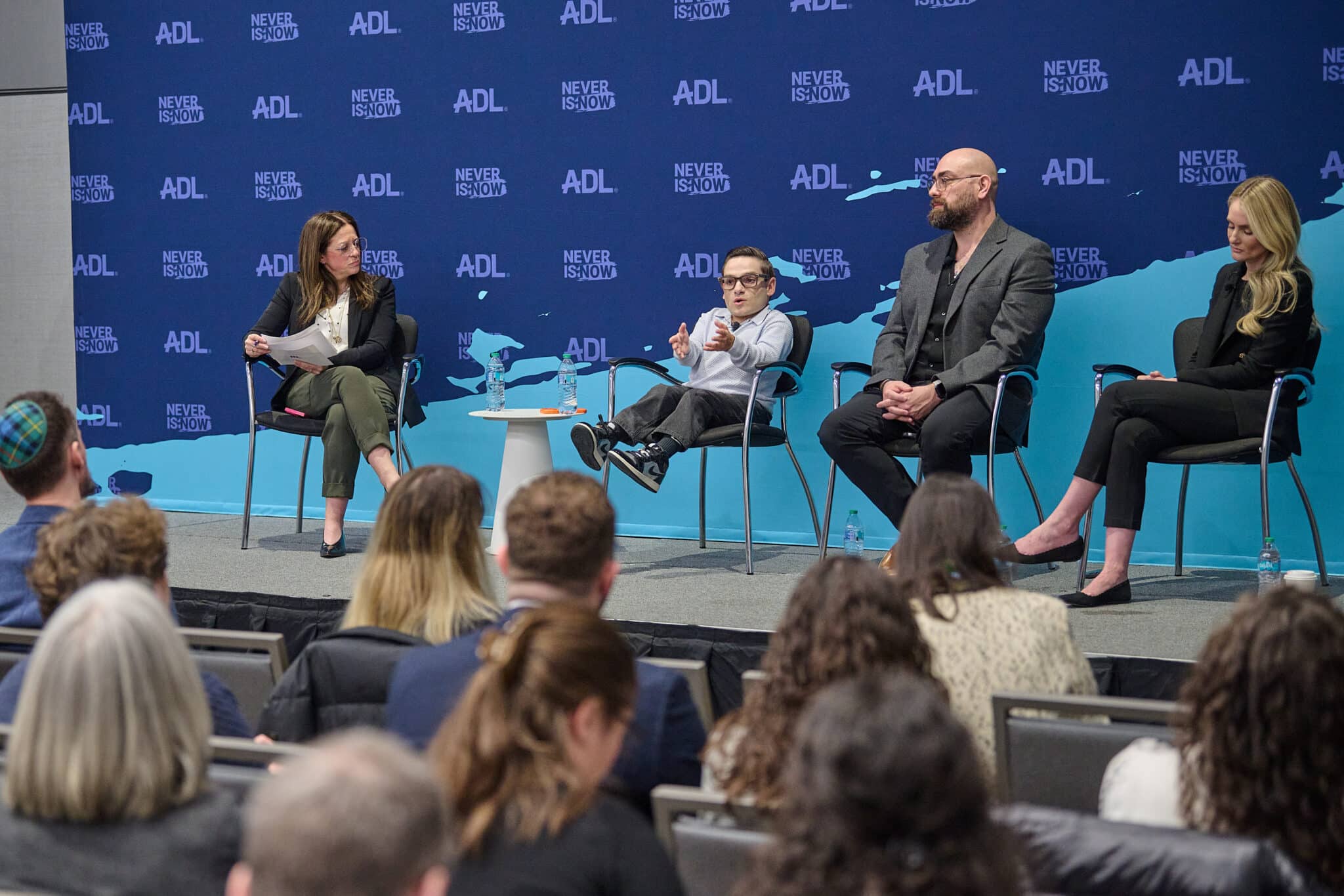
Pinchuk moderated the panel “Effectively Advocating Against Antisemitism Online and Off” and described herself as someone who had not set out to become an activist. She said that changed after she posted a vlog from a Whole Foods on October 8. When the video received 100,000 views, she saw it as a call to action. “I have shown up online every single day since,” said Pinchuk, founder of the popular “Dear FoundHer” podcast about women entrepreneurs.
She also offered practical advice for families dealing with antisemitism in schools. If a student reports an incident to their parents, she said, the parents should first go to the principal. If the school fails to respond, they should escalate the matter to the superintendent.
Alyssa Rosenheck spoke about the moment that first pushed her into advocacy. In middle school, she said, a classmate lost her wallet, stood up, pointed at her, and declared, “The Jew took it.” “I pushed her down,” Rosenheck said, while quickly adding that she does not condone violence. “I got in trouble. I grew up in Tulsa, Oklahoma. There wasn’t a large Jewish community, and I learned to be very proud of who I was.”
Rosenheck, an architectural photographer, said her forthcoming book, “White Blonde Jew,” will be released in August.
Benjy Rosenzweig, a public speaker and advocate in both the special needs and recovery communities, said he had never thought of himself as a Jewish activist before October 7. But in the days that followed, he said, he was shaken by how some people in his own circles responded. “I saw my friends in these spaces turn their profile pictures into paragliders with Palestinian flags,” he said. “I said, ‘What are you doing? You’re an advocate. We go to concerts together. We go to music festivals together, and those paragliders murdered hundreds of people at a music festival. What are you doing?’”
According to Rosenzweig, some responded by telling him, “Don’t worry about you. We’re not coming after you. We’re just coming after the bad ones.” “And I said, ‘Pardon my French, mother—-er, I’m one of the bad ones,’” he said. “I wasn’t thinking of fighting antisemitism. I was thinking of my friends and their misconceptions.”
Rosenzweig said one woman later thanked him for his videos online, but told him she was too afraid to speak publicly because she feared losing her job. One practical tip he offered was to avoid arguing with people in the comment sections of their own platforms. Instead, he suggested responding on your own platform, where you control the framing and the audience.
Brandon Farbstein, an influencer who works with major brands and has built a devoted following online, also spoke on the panel. Born with an extremely rare form of dwarfism, Farbstein is a well-known speaker and author who has also helped drive anti-bullying legislation. He said he last saw Hersh Goldberg-Polin when they were both 5 years old in preschool, and was devastated to learn that his former classmate had been taken hostage and ultimately murdered. “I knew if the position was turned, he’d be shouting from the rooftops,” Farbstein said.
His advice to would-be advocates was simple: before posting anything, do a quick Google search to make sure it is true.
Changing minds with every post?
Farbstein said that in an online environment flooded with constant noise, truly listening to one another has become “so freaking hard.” Still, he made clear that he does not see every post as an opportunity to convert someone to his worldview. “I’m not trying to change your worldview,” he said, explaining his approach. “I’m just trying to share how I see things, and if that makes you reframe things, amazing. But if not, go do your own thing.”
For Farbstein, the goal is less about winning every argument than about speaking honestly and creating space for others to think differently. He added that it is often better not to engage with people who are simply trying to provoke outrage. Rosenzweig echoed that point, saying some people online are not interested in dialogue at all. Instead, he said, they are looking to inflame tensions, create division, and tear down bridges rather than build them. “I don’t have to show up to every fight I’m invited to,” Rosenzweig said.
That became one of the clearest takeaways from the panel: effective advocacy does not mean responding to every hostile comment or bad-faith attack. Sometimes it means recognizing when a conversation has the potential to be productive, and when it is better to disengage. Pinchuk, striking a lighter note, said one cheeky way to deal with online antagonists is to tell them a donation has been made to the ADL in their honor, a line that drew laughs while underscoring the panel’s broader point about refusing to be dragged into every pointless fight.
Farbstein also offered a direct message to the Gen Z Jews in the audience, urging them not to underestimate the power of a single voice.
“I think it’s so easy to get overwhelmed at us being one person, one voice in a sea of so many people,” he said. “Who are we? I don’t have tens of millions of followers. I don’t have all this money. We could make up so many excuses. I passed two laws by my 18th birthday because I decided to speak up. I decided to use what I’ve been given.”
Farbstein said he bristles at the common refrain that young people are merely the next generation of leaders. “I hate when people are like, ‘you’re the next generation of leaders.’ No, that’s BS,” he said. “We’re the now generation of leaders, and we’re showing up.”
Other panelists echoed that sentiment, saying advocates should not be paralyzed by the fear of losing followers or alienating parts of their audience. In some cases, they said, people may unfollow in the moment, only to return later with a different perspective and a greater willingness to engage with the facts.
Milgrim parents remember their murdered daughter
Sarah Milgrim, 26, who organized trips to Israel for the Israeli Embassy, was murdered on May 21, 2025, at the Capital Jewish Museum in Washington, D.C., along with her fiancé, Yaron Lischinsky, who also worked for the embassy. The two were shot and killed by a domestic terrorist who later shouted, “Free Palestine.” The event they had attended was focused on building bridges among Jews, Muslims, and Christians.
Speaking at the conference, Sarah’s parents, Bob and Nancy Milgrim, reflected on the values that shaped their daughter long before her death.
They recalled that at Sarah’s school in Kansas City, she served as president of a small Jewish student group of just 10 to 12 people. At one point, when someone spray-painted a swastika on campus, she was asked what should happen to the perpetrator. Her answer, they said, was that the person should not simply be punished, but educated.
That instinct, her parents suggested, captured something essential about who Sarah was: someone committed not only to standing up to hate, but to trying to change the conditions that allow it to grow.
Nancy Milgrim said the grief remains as raw as ever. “I’m not any less sad than I was on May 21,” she said.
Bob Milgrim said the family was sustained in the aftermath by an outpouring of love and support from people across the country. “Without that, I don’t know how I would have gotten through this,” he said. They also shared one detail that spoke to the care shown in the midst of tragedy: the FBI made sure Sarah’s dog was safely sent to them in Kansas City.
Arab-Israeli TV presenter Lucy Aharish wins Abraham Award
Lucy Aharish, the first Muslim anchor on a major Israeli news broadcast and a Reshet 13 news anchor, was one of the conference’s most emotional speakers. Appearing remotely from Israel, she accepted the “Abraham” Award and spoke about the threats she and her family have faced during this tumultuous period. “It feels as if we are living in an era where some of our leaders have decided to give up on the younger generation,” she said, adding that she had recently been targeted by a racist right-wing group.
Aharish said that after remarks from one of her segments were taken out of context, she was subjected to a wave of abuse, with people calling her a “filthy Arab” and a terrorist. At one point, she said, 15 men came to her door demanding to speak with her. She explained that this was not the first time her family had faced such hatred. Fifty-two years earlier, when her family moved from Nazareth to Dimona as the town’s only Muslim family, followers of Rabbi Meir Kahane sent threatening letters telling them they should leave.
Aharish said her mother brought those letters to “Grandpa Menachem,” a Jewish man with a tattoo on his arm, who one night told her about surviving the Holocaust. “He always knew how to comfort me with the best candies,” Aharish said. She recalled him telling her, “I didn’t go through everything that I went through, survive evil, come to the land of Israel, and start a family against all odds so that you would feel threatened here. They will have to reach me before they get to you.”
Aharish also spoke about her soulmate, “Fauda” actor Tsahi Halevi, and their son Adam, whom she described as both a proud Jew and a proud Muslim. She credited the vocal majority in Israel who spoke out on her behalf and said she would continue fighting for Israel and against antisemitism.
Emanuel Acho awarded Ally Award
Former NFL player, podcaster, and sports media personality Emmanuel Acho received the Ally Award. In his remarks, he reflected on how his own public advocacy began after the murder of George Floyd, when he was living in Austin, Texas.
Acho said he launched “Uncomfortable Conversations With a Black Man” in response to that moment. After actor Matthew McConaughey reached out to participate in an episode, the project grew quickly and eventually led Acho to write several books, including “Uncomfortable Conversations with a Jew,” which he co-authored with Noa Tishby.
“He realized,” Acho said, “the Jewish community and the Black community have far too much in common to not be fighting together.”
He also shared a personal story about antisemitism that helped crystallize that connection for him. While eating sushi at a restaurant in North Hollywood, he said, a woman approached him and remarked, “I hope they paid you well.” Acho said he asked who she meant by “they.” After some back-and-forth, she finally answered: “Zionists.”
In that moment, he said, he understood something more viscerally than before: “This is how it feels to be Jewish.”
Defiant outlook
Despite the very real fear surrounding antisemitism, numerous speakers said they refuse to hide their Judaism. Again and again, the message from the conference was that silence cannot be the answer, and that Jews should not allow intimidation, bullying, or hatred to push them away from their identity. Rosenheck echoed that sentiment on her panel, urging Jews to remember their history and carry themselves with pride.
“You know, our ancestors walked through fire and carried storms on their back,” Rosenheck said. “And we’re not gonna be complicit or silent in our own erasure. We’re just not doing that.”
Alan Zeitlin